By the end of this lecture, you should be able to:
- define thermal conductivity through Fourier’s law and distinguish scalar from tensor thermal conductivity;
- derive the kinetic-theory expression for lattice thermal conductivity from a phonon heat-current picture;
- explain how phonon heat capacity, group velocity, and mean free path control \(\kappa\);
- distinguish normal processes, umklapp processes, defect scattering, isotope scattering, and boundary scattering;
- explain the characteristic temperature dependence of \(\kappa(T)\) in crystalline and amorphous solids;
- describe the quantized thermal conductance of a one-dimensional ballistic solid.
10.1 Definition of Thermal Conductivity
Heat transport in a solid can be carried by phonons, electrons, magnons, or other excitations. In this lecture we focus on the lattice contribution, which is the dominant heat-transport channel in insulating crystals and glasses.
In metals, the electronic contribution is often larger. This does not mean that insulating crystals are necessarily poor heat conductors. At low temperatures, very pure dielectric crystals can have thermal conductivities comparable to or even larger than those of many metals.
The thermal conductivity \(\kappa\) is defined by Fourier’s law, \[ \mathbf J_h = -\boldsymbol{\kappa} \nabla T. \]
Here \(\mathbf J_h\) is the heat-current density and \(\nabla T\) is the temperature gradient. The minus sign states that heat flows from hot to cold.
For an isotropic solid, the tensor \(\boldsymbol\kappa\) reduces to a scalar: \[ \mathbf J_h = -\kappa \nabla T. \]
In one-dimensional transport along \(x\), \[ J_{h,x} = -\kappa \frac{\partial T}{\partial x}. \]
The unit of \(\kappa\) is \[ [\kappa] = \mathrm{W\, m^{-1}\, K^{-1}}. \]
A useful analogy is a gas between a hot wall and a cold wall. Molecules arriving from the hot side carry, on average, more energy than molecules arriving from the cold side. A phonon gas behaves similarly: phonons moving from hotter regions carry more vibrational energy than phonons moving from colder regions.
In a solid with no net particle flow, there may be equal numbers of carriers moving left and right, but their average energies differ. That energy imbalance produces the heat current.
10.2 Phonon Heat Current
10.2.1 Energy Carried by a Mode
A phonon mode \((q,r)\) has energy quantum \(\hbar\omega_{qr}\). Its propagation velocity is the group velocity, \[ v_x(q,r) = \frac{\partial \omega_{qr}}{\partial q_x}. \]
The heat current in the \(x\)-direction is obtained by summing the energy carried by all modes, weighted by their velocity component: \[ J_{h,x} = \frac{1}{V} \sum_{q,r} \hbar\omega_{qr} \left( \frac{1}{2} + \langle n_{qr}\rangle \right) v_x(q,r). \]
The factor \(\frac{1}{2}\) is the zero-point contribution of each harmonic oscillator.
In thermal equilibrium, \[ J_{h,x}=0. \]
The cancellation follows from two facts:
\[ \langle n_{qr}\rangle = \langle n_{-q,r}\rangle, \]
but \[ v_x(q,r) = -v_x(-q,r). \]
Thus each mode moving to the right is balanced by a mode moving to the left. The zero-point term also cancels pairwise and does not produce a heat current.
A finite heat current requires a deviation from local equilibrium. We therefore write \[ \delta n = \langle n\rangle - \langle n\rangle^0, \]
where \(\langle n\rangle^0\) is the local-equilibrium Bose-Einstein occupation number at the local temperature. The heat current becomes \[ J_{h,x} = \frac{1}{V} \sum_{q,r} \hbar\omega_{qr} \left( \langle n\rangle - \langle n\rangle^0 \right) v_x(q,r). \]
10.2.2 Local Equilibrium and the Relaxation-Time Approximation
We assume that the temperature varies slowly on microscopic length scales. Then each small region of the solid can still be assigned a local temperature \(T(x)\) and a local-equilibrium occupation \(\langle n\rangle^0[T(x)]\).
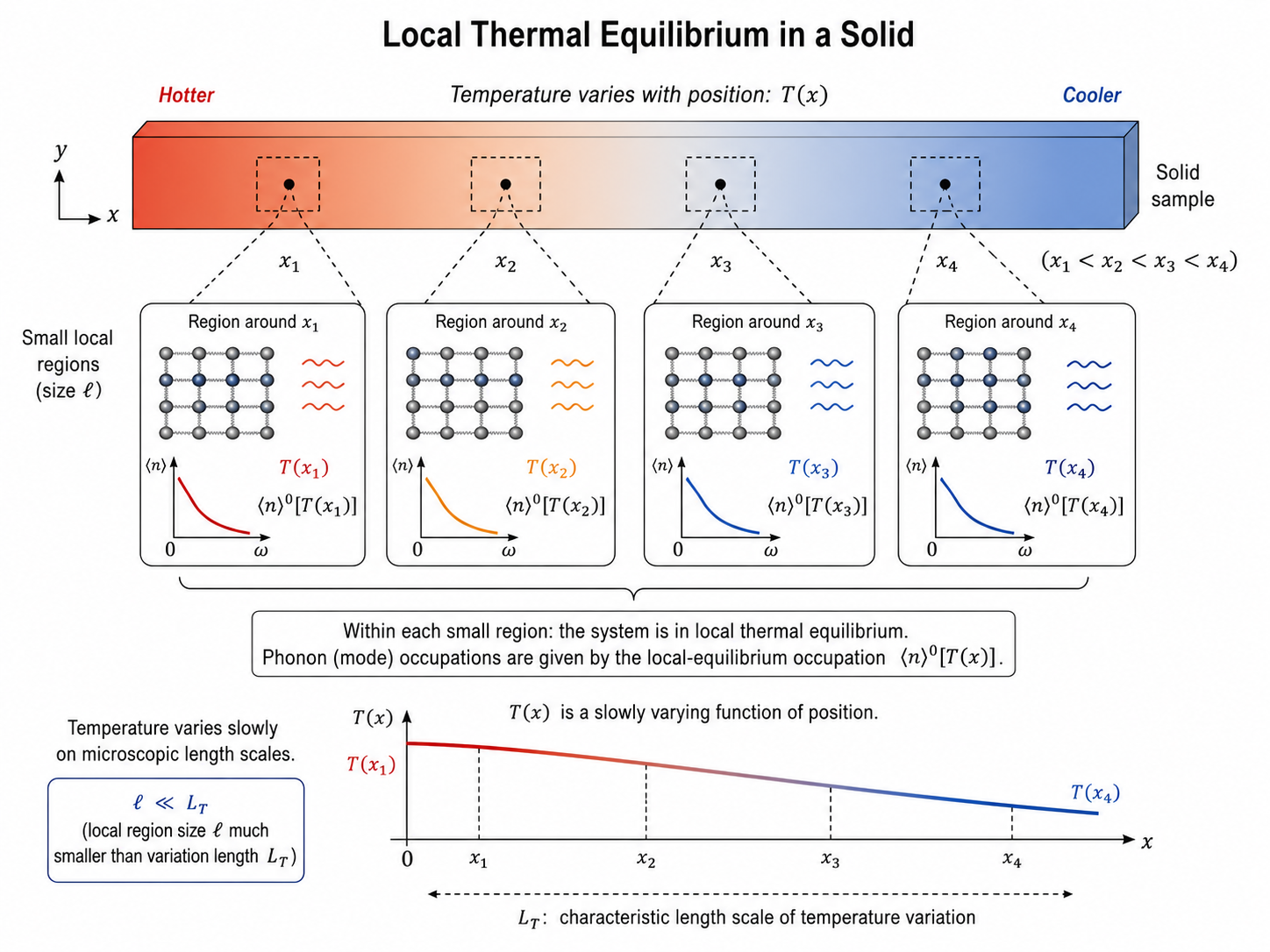
The occupation number changes by two mechanisms:
- diffusion: phonons move into and out of the region;
- scattering: relaxes the occupation distribution back toward local equilibrium.
This is expressed as \[ \frac{d\langle n\rangle}{dt} = \left( \frac{\partial \langle n\rangle}{\partial t} \right)_{\mathrm{Diffusion}} + \left( \frac{\partial \langle n\rangle}{\partial t} \right)_{\mathrm{Scattering}}. \]
For a stationary state, \[ \frac{d\langle n\rangle}{dt}=0. \]
The relaxation-time approximation writes the scattering term as \[ \left( \frac{\partial \langle n\rangle}{\partial t} \right)_{\mathrm{Scattering}} = - \frac{ \langle n\rangle-\langle n\rangle^0 }{\tau}. \]
Here \(\tau\) is the relaxation time. It measures how rapidly scattering processes erase the nonequilibrium part of the distribution.
For the diffusion term, consider phonons arriving at position \(x\) from the earlier position \(x-v_x\Delta t\). Expanding for small \(\Delta t\) gives \[ \left( \frac{\partial \langle n\rangle}{\partial t} \right)_{\mathrm{Diffusion}} =-v_x \frac{\partial \langle n\rangle}{\partial x}. \]
Using local equilibrium, \[ \frac{\partial \langle n\rangle}{\partial x} \simeq \frac{\partial \langle n\rangle^0}{\partial T} \frac{\partial T}{\partial x}, \]
so that \[ \left( \frac{\partial \langle n\rangle}{\partial t} \right)_{\mathrm{Diffusion}} = -v_x \frac{\partial \langle n\rangle^0}{\partial T} \frac{\partial T}{\partial x}. \]
Combining the stationary condition with the relaxation ansatz yields \[ 0= -v_x \frac{\partial \langle n\rangle^0}{\partial T} \frac{\partial T}{\partial x} - \frac{ \langle n\rangle-\langle n\rangle^0 }{\tau}. \]
Therefore \[ \langle n\rangle-\langle n\rangle^0 = -\tau\, v_x \frac{\partial \langle n\rangle^0}{\partial T} \frac{\partial T}{\partial x}. \]
This result has a simple interpretation. A phonon carries information about the temperature at its last scattering event. The longer the time \(\tau\) between scattering events, the larger the imbalance produced by a given temperature gradient.
10.3 Kinetic-Theory Expression for \(\kappa\)
Substituting the nonequilibrium occupation into the heat-current expression gives \[ J_{h,x} = - \frac{1}{V} \sum_{q,r} \hbar\, \omega_{qr}\, \tau\, v_x^2 \frac{\partial \langle n\rangle^0}{\partial T} \frac{\partial T}{\partial x}. \]
Comparison with Fourier’s law, \[ J_{h,x} = -\kappa \frac{\partial T}{\partial x}, \]
gives \[ \kappa = \frac{1}{V} \sum_{q,r} \hbar\, \omega_{qr}\, \tau\, v_x^2 \frac{\partial \langle n\rangle^0}{\partial T}. \]
For a cubic or isotropic solid, \[ \langle v_x^2\rangle = \frac{1}{3}v^2. \]
Thus \[ J_{h,x} =- \frac{1}{3V} \sum_{q,r} \hbar\omega_{qr}\, \tau\, v^2\, \frac{\partial \langle n\rangle^0}{\partial T} \frac{\partial T}{\partial x}. \]
The heat capacity per unit volume is \[ c_V = \frac{1}{V} \sum_{q,r} \hbar\, \omega_{qr}\, \frac{\partial \langle n\rangle^0}{\partial T}. \]
Introducing the mean free path \[ \ell = v\tau, \]
we obtain the central kinetic result: \[ \boxed{ \kappa = \frac{1}{3} c_V v\ell } \]
The three factors have distinct meanings:
- \(c_V\) measures how much vibrational energy is available to transport;
- \(v\) measures how fast the energy propagates;
- \(\ell\) measures how far the energy travels before its direction or momentum is randomized.
A more detailed expression keeps the branch and frequency dependence: \[ \kappa = \frac{1}{3} \sum_r \int \frac{dc_{V,r}}{d\omega} v_r(\omega) \ell_r(\omega) d\omega. \]
This form shows why optical phonons and zone-edge acoustic phonons often contribute weakly to heat transport: they may be occupied, but their group velocities are small.
10.3.1 Kinetic-Gas Interpretation
The same expression can be understood without the full mode sum.
Consider phonons as particles in a gas. A phonon typically travels a distance \(\ell\) between scattering events. If the temperature gradient is \(dT/dx\), then the temperature difference sampled over one free path is approximately \[ \Delta T \simeq \ell \frac{dT}{dx}. \]
The energy imbalance transported by moving phonons is proportional to \(c_V\Delta T\). Multiplying by a characteristic velocity and averaging over directions gives \[ J_{h,x} = -\frac{1}{3}c_V v\ell \frac{dT}{dx}. \]
This again gives \[ \kappa = \frac{1}{3}c_Vv\ell. \]
The factor \(\frac{1}{3}\) is geometric. In three dimensions only one third of the squared velocity contributes, on average, to transport along a chosen axis.
10.4 Scattering Processes
The temperature dependence of \(\kappa\) is controlled mainly by two factors: \[ \kappa(T) \simeq \frac{1}{3}c_V(T)v\ell(T). \]
The heat capacity \(c_V(T)\) was discussed in the preceding lectures. The new question is the behavior of \(\ell(T)\).
10.4.1 Matthiessen’s Rule
In nonmetals, the most important phonon scattering mechanisms are:
- phonon-phonon scattering;
- scattering from defects, impurities, isotopes, and surfaces.
If several independent scattering mechanisms are active, their inverse mean free paths add: \[ \frac{1}{\ell} = \frac{1}{\ell_1} + \frac{1}{\ell_2} + \frac{1}{\ell_3} +\cdots. \]
This is the phonon analogue of Matthiessen’s rule. The strongest scattering channel usually dominates because the shortest mean free path gives the largest inverse mean free path.
10.4.2 Defect and Boundary Scattering
Defects and surfaces break translational invariance. They scatter phonons and limit \(\ell\) even if phonon-phonon scattering is weak.
For a fixed defect density \(n_D\) and scattering cross section \(\sigma\), \[ \ell \propto \frac{1}{n_D\sigma}. \]
For point defects smaller than the phonon wavelength, Rayleigh-type scattering gives approximately \[ \sigma \simeq \pi a^2(aq)^4, \]
where \(a\) is the characteristic size of the scattering center. With \(\omega\propto q\) for acoustic phonons, \[ \ell \propto \frac{1}{n_D\omega^4}. \]
Thus point defects scatter high-frequency phonons much more strongly than low-frequency phonons.
At sufficiently low temperature, intrinsic phonon-phonon scattering becomes so weak that the mean free path can be limited by the sample dimensions: \[ \ell \simeq d. \]
This is the Casimir regime. In this regime the thermal conductivity depends on sample geometry and surface quality.
10.4.3 Isotope Scattering
Even an otherwise perfect crystal can scatter phonons if it contains a random distribution of isotopes. Isotopes occupy the same crystallographic sites, but they have different masses. The periodicity of the mass distribution is therefore imperfect.
The effect is experimentally large in materials such as Si and Ge. Isotopically purified crystals can have much larger peak thermal conductivities than natural-abundance crystals.
10.4.4 Normal and Umklapp Processes
Phonon-phonon scattering is caused by anharmonicity. In a perfectly harmonic crystal, normal modes do not interact and phonons would have infinite lifetimes. Real crystals are anharmonic, so phonons can scatter from one another.
The most important anharmonic scattering events are often three-phonon processes. Two phonons can combine into one, or one phonon can decay into two.
For a three-phonon process, energy conservation requires \[ \hbar\omega_3 = \hbar\omega_1 + \hbar\omega_2. \]
Wave-vector conservation in a crystal has the form \[ q_3+G = q_1+q_2, \]
where \(G\) is a reciprocal-lattice vector chosen so that the resulting phonon wave vector lies in the first Brillouin zone.
10.4.4.1 Normal Processes
For a normal process, \[ G=0, \]
so \[ q_1+q_2=q_3. \]
The total crystal momentum of the phonon gas is conserved: \[ Q = \sum_{q,r} \langle n_{qr}\rangle\hbar q_r = \mathrm{const}. \]
Normal processes redistribute energy and momentum among phonons, but they do not directly relax the net drift of the phonon gas.
A useful analogy is a crowd moving down a corridor. People may bump into one another and exchange positions, but if the crowd as a whole keeps moving forward, those internal collisions do not stop the flow.
10.4.4.2 Umklapp Processes
For an umklapp process, \[ G\ne 0. \]
The condition can be written as \[ q_1+q_2=q_3+G. \]
The reciprocal-lattice vector represents crystal momentum transferred to the lattice. Therefore the total momentum of the phonon gas can change, and the heat current can relax.
10.5 Temperature Dependence of Thermal Conductivity in Crystals
10.5.1 Overall behavior
The full qualitative behavior of a clean insulating crystal is:
\[ \kappa \propto \begin{cases} T^3, & T \llless \Theta_D & \text{very low } T \text{phonon-defect scattering},\\ T^n e^{\Theta_D/T}, & T \ll \Theta_D & \text{phonon-phonon scattering (Umklapp process)},\\ 1/T, & T \gg \Theta_D & \text{strong phonon-phonon scattering}. \end{cases} \]
Here \(n\) is a model-dependent exponent, typically between \(0\) and \(3\) in simple estimates.
Note that throughout the kinetic-theory treatment of thermal conductivity, the group velocity is assumed to be essentially independent of temperature at all temperatures. The temperature dependence of the thermal conductivity comes then almost entirely from the heat capacity and the mean free path. Their behavior under high and low temperature is analyzed below.
10.5.2 High Temperatures
At high temperature, roughly \(T\gg \Theta_D\), the phonon heat capacity approaches the Dulong-Petit limit and is approximately temperature independent: \[ c_V \simeq \mathrm{const}. \]
Umklapp scattering is then frequent. In a simple estimate, \[ \ell \propto \frac{\Theta_D}{T}. \]
Therefore \[ \kappa \propto \frac{1}{T}. \]
At high temperature, thermal resistance grows because the phonon gas becomes dense: phonons collide more often, and umklapp events are common.
10.5.3 Intermediate Temperatures
Upon cooling from high temperature, umklapp scattering becomes less probable. The mean free path increases rapidly. Over a broad intermediate range, this increase in \(\ell\) can dominate over the decrease in \(c_V\).
As a result, \(\kappa(T)\) rises as temperature is lowered.
The rough condition for umklapp scattering is that the sum of incoming wave vectors must be large enough to reach a Brillouin-zone boundary: \[ q_1+q_2 \gtrsim \frac{1}{2}G. \]
In the Debye estimate, this requires phonons with energies of order \(k_B\Theta_D/2\). Their occupation is approximately \[ \langle n\rangle = \frac{1}{e^{\Theta_D/(2T)}-1}. \]
Thus, for \(T\ll\Theta_D\), \[ \langle n\rangle \propto e^{-\Theta_D/(2T)}. \]
Consequently, the mean free path associated with umklapp scattering grows approximately exponentially on cooling.
10.5.4 Low Temperatures
At sufficiently low temperature, umklapp scattering becomes very weak. The mean free path is then limited by defects, isotopes, or boundaries.
For a clean crystal in the boundary-limited regime, \[ \ell \simeq d = \mathrm{const}. \]
The Debye heat capacity of acoustic phonons behaves as \[ c_V \propto T^3. \]
Therefore \[ \kappa \propto T^3. \]
10.6 Spontaneous Decay of Phonons
At very low temperature, one might expect phonons to live indefinitely because there are almost no thermally excited phonons left to scatter from. This expectation is not completely correct.
Zero-point fluctuations remain even at \(T=0\). A phonon can interact with these fluctuations and decay through anharmonic three-phonon processes.
For spontaneous decay, the scattering cross section scales as \[ \sigma \propto \omega^3. \]
Since the density of available final states scales as \[ D(\omega) \propto \omega^2, \]
one obtains \[ \ell \propto \tau \propto \frac{1}{\omega^5}. \]
This mechanism is relevant mainly for high-frequency phonons. Long-wavelength, low-frequency acoustic phonons can still have very long lifetimes.
10.7 Thermal Conductivity in Amorphous Solids
The preceding discussion assumed a crystalline solid, where phonons can be labeled by wave vector and branch. In amorphous solids, long-range translational symmetry is absent. The phonon picture remains useful for long-wavelength vibrations, but it becomes less reliable when the mean free path becomes comparable to the wavelength.
Experiments on amorphous solids show behavior very different from crystalline solids.
10.7.1 High-Temperature Regime
At high temperature, the dominant vibrational wavelengths in amorphous solids can be of order \(1,\mathrm{nm}\). Estimates from the measured thermal conductivity can give mean free paths below or comparable to this wavelength.
In that situation, the picture of well-defined weakly scattered phonons becomes questionable. Heat transport is then better viewed as energy diffusion through a disordered vibrational network rather than as transport by long-lived plane-wave phonons.
10.7.2 Plateau Regime
At intermediate temperatures, many amorphous solids show an approximate plateau in \(\kappa(T)\).
From \[ \kappa \simeq \frac{1}{3}c_Vv\ell, \]
a plateau means that the growth of \(c_V\) must be compensated by a decrease of \(\ell\).
Possible mechanisms include:
- strong scattering from structural disorder;
- localization tendencies of vibrational modes;
- scattering from soft local modes.
The contrast with crystals is direct. In a clean crystal, cooling can make \(\ell\) extremely long. In a glass, disorder keeps \(\ell\) short over a wide range of temperatures.
10.7.3 Very Low Temperatures and Two-Level Systems
At very low temperatures, many amorphous solids show approximately \[ \kappa \propto T^2. \]
This differs from the crystalline boundary-limited result \(\kappa\propto T^3\).
A common explanation uses tunneling two-level systems in the disordered structure. These may be local atomic configurations that can tunnel between two nearly equivalent positions.
If the two levels are separated by energy \(E_{12}\), resonant phonon scattering is strongest when \[ E_{12} = \hbar\omega. \]
The occupation difference between the two levels is \[ \delta n = n_2-n_1 = n_{\mathrm{TLS}} \tanh \left( \frac{E_{12}}{2k_BT} \right) = n_{\mathrm{TLS}} \tanh \left( \frac{\hbar\omega}{2k_BT} \right). \]
For the phonons that dominate heat transport, \(\hbar\omega\sim k_BT\), so this occupation difference is only weakly temperature dependent. If the scattering rate scales approximately as \(1/\ell\propto T\) while \(c_V\propto T^3\), then \[ \kappa = \frac{1}{3}c_Vv\ell \propto T^2. \]
10.8 Thermal Transport in a One-Dimensional Solid
Modern micro- and nanostructures can confine phonons so strongly that only a small number of transverse modes remain thermally active.
The relevant length scale is the thermal wavelength \(\lambda_{\mathrm{th}}\), defined by \[ \hbar\omega_{\mathrm{th}} = \frac{2\pi\hbar v}{\lambda_{\mathrm{th}}} = k_BT. \]
Vibrational modes with wavelengths shorter than this are not thermally occupied. If a transverse dimension \(D\) satisfies \[ D \le \frac{\lambda_{\mathrm{th}}}{2}, \]
then motion in that direction is effectively frozen out.
The corresponding crossover temperature is \[ T^\ast = \frac{hv}{2k_BD}. \]
For \(v\simeq 5000,\mathrm{m/s}\) and \(D\simeq 100,\mathrm{nm}\), this gives a crossover temperature of order \(1,\mathrm{K}\).
10.8.1 Heat Current in One Dimension
Consider a one-dimensional bridge of length \(L\) between two reservoirs at temperatures \(T_1\) and \(T_2<T_1\).
The heat current is \[ J_{h,x} = \frac{1}{L} \sum_{q,r} \hbar\omega_{qr} \left( \langle n_1\rangle - \langle n_2\rangle \right) v_{x,qr}. \]
Here \(\langle n_1\rangle\) and \(\langle n_2\rangle\) are the thermal occupation numbers imposed by the hot and cold reservoirs.
Using the one-dimensional density of states \[ Z^{(1)}(q) = \frac{L}{2\pi}, \]
and the relation \[ Z(q)\,dq = D(\omega)\,d\omega, \]
we obtain \[ D(\omega) = \frac{L}{2\pi} \frac{1}{v_{x,qr}}. \]
The group velocity cancels in the current, giving \[ J_{h,x} = \frac{1}{2\pi} \sum_r \int_0^\infty \hbar\omega_r \left( \langle n_1\rangle - \langle n_2\rangle \right) d\omega_r. \]
The cancellation of velocity is important. A slower mode has a larger density of states, and these two effects compensate in the ballistic one-dimensional limit.
10.8.2 Quantum of Thermal Conductance
In the ballistic limit, the mean free path exceeds the bridge length: \[ \ell > L. \]
Phonons emitted by one reservoir reach the other reservoir without backscattering. In linear response, for \(\Delta T=T_1-T_2\), the thermal conductance is \[ G_{\mathrm{th}} \equiv \frac{J_{h,x}}{\Delta T}. \]
Using \[ x = \frac{\hbar\omega}{k_BT}, \]
one obtains \[ G_{\mathrm{th}} = \frac{k_B^2T}{h} \sum_r T_r \int_0^\infty \frac{x^2e^x}{(e^x-1)^2} dx. \]
The integral is \[ \int_0^\infty \frac{x^2e^x}{(e^x-1)^2} dx = \frac{\pi^2}{3}. \]
Therefore \[ G_{\mathrm{th}} = \sum_r T_r \frac{\pi^2k_B^2T}{3h}. \]
For an ideal mode with \(T_r=1\), the contribution is \[ G_0 = \frac{\pi^2k_B^2T}{3h}. \]
This is the quantum of thermal conductance per mode.
If \(N_i\) modes are perfectly transmitted, \[ G_{\mathrm{th}} = N_iG_0. \]
Each bridge contributes four vibrational modes, and four bridges act in parallel. The low-temperature conductance is therefore expected to approach \(16G_0\).
- Thermal conductivity is a nonequilibrium response to a temperature gradient.
- In an insulating crystal, heat is carried mainly by phonons.
- Equilibrium phonons store energy but do not carry net heat current.
- Large lattice thermal conductivity requires thermally active modes, large group velocities, and long mean free paths.
- Normal phonon processes redistribute momentum inside the phonon gas, whereas umklapp processes relax the heat current.
- Crystalline insulators show a thermal-conductivity peak because scattering weakens on cooling before the heat capacity collapses.
- Disorder suppresses the phonon mean free path and gives amorphous solids their characteristic plateau.
- A one-dimensional ballistic solid has a universal thermal conductance per transmitted vibrational mode.
Problem Set
Fourier’s Law and Units. Starting from \[ \mathbf J_h=-\kappa\nabla T, \] determine the SI unit of \(\kappa\). Explain the physical meaning of the minus sign.
Derivation of the Kinetic Formula. Starting from \[ J_{h,x} = \frac{1}{V} \sum_{q,r} \hbar\, \omega_{qr}\, \delta n\, v_x, \] with \[ \delta n = -\tau v_x \frac{\partial \langle n\rangle^0}{\partial T} \frac{\partial T}{\partial x}, \] derive \[ \kappa = \frac{1}{3}c_Vv\ell \] for an isotropic solid with one characteristic phonon velocity and mean free path.
Normal and Umklapp Processes. Explain the difference between \[ q_1+q_2=q_3 \] and \[ q_1+q_2=q_3+G. \] Which process directly produces thermal resistance in the simple phonon-gas picture?
Temperature Dependence in a Clean Crystal. Use \[ \kappa\simeq \frac{1}{3}c_Vv\ell \] to explain why a clean insulating crystal can show \(\kappa\propto T^3\) at very low temperature, a maximum at intermediate temperature, and approximately \(\kappa\propto 1/T\) at high temperature.
Defect Scattering. For Rayleigh scattering from point defects, \[ \ell \propto \frac{1}{n_D\omega^4}. \] Explain which phonons are most strongly affected and how increasing defect density changes the thermal-conductivity curve.